Currents in the Nusa Penida Marine Park.
Currents in the Nusa Penida Marine Park.
Over a full month lunar cycle we installed current meters to record data at our two coral restoration projects:
Sental Reef, Nusa Penida
Mangrove Reef, Nusa Lembongan

Blue Corner Conservation is an environmental NGO focused on coral reef restoration and scientific education though our Blue Corner Marine Research programs. Based in Indonesia our team of dedicated marine biologists and dive professionals have a global impact.
Currents in the Nusa Penida Marine Park.
Over a full month lunar cycle we installed current meters to record data at our two coral restoration projects:
Sental Reef, Nusa Penida
Mangrove Reef, Nusa Lembongan
Coral restoration increasingly relies on outplanting branching Acropora spp., yet the influence of outplant configuration on growth performance remains poorly resolved. We tested whether monoculture versus mixed-species outplantings affect growth of Acropora parahemprichii and A. muricata at a restoration site in Nusa Penida, Indonesia. Nine 1-m² metal reef structures were deployed at 5 m depth, with three structures each assigned to A. parahemprichii monoculture, A. muricata monoculture, or mixed outplantings. Each structure received 30 standardized fragments (~80 mm). Growth was monitored over 50 weeks using planar area derived from maximum length and width measurements. ANCOVA models revealed significant Treatment × Week interactions for both species, indicating reduced growth in mixed relative to monoculture outplantings. A. parahemprichii grew 483 mm² week⁻¹ (95% CI: 441–525) in monoculture versus 290 mm² week⁻¹ (95% CI: 174–406) in mixed plots (p = 0.015). A. muricata exhibited an even stronger response, with monoculture colonies growing nearly twice as fast (881 mm² week⁻¹, 95% CI: 693–1070) as those in mixed assemblages (454 mm² week⁻¹, 95% CI: 423–486; p < 0.001). These results demonstrate that outplant configuration can significantly influence coral growth trajectories, with monoculture enhancing early growth for both species. While mixed outplantings may promote diversity and long-term resilience, incorporating monoculture patches could accelerate short-term biomass accumulation in reef restoration projects.
Read MoreEarly Ecosystem Function Recovery at a Coral Restoration site Revealed Through Process-Based Monitoring Indicators
Coral reef restoration is increasingly implemented worldwide, yet monitoring commonly focuses on structural endpoints such as survival or coral cover rather than ecological function. This study evaluates early signals of ecosystem function recovery at a coral restoration site established on a degraded rubble reef within the Nusa Penida Marine Protected Area, Indonesia. Monitoring was conducted across 76 artificial reef structures using diver observations and orthogonal photography to quantify benthic composition, structural development, recruitment pathways, trophic interactions, and transplant health. Relationships among monitoring indicators were examined using Spearman correlation analysis to identify linkages between ecosystem characteristics at both the restoration structure and colony levels. Live hard coral and soft coral cover increased significantly with structure age (ρ = 0.60 and 0.50 respectively, p < 0.001), indicating early benthic succession. Coral recruitment showed a strong positive association with coral genus richness (ρ ≈ 0.57), suggesting that more taxonomically diverse restoration structures supported greater establishment of new colonies. Recruitment was dominated by retained fragments (77%) rather than larval settlement (23%), highlighting the importance of fragmentation during early site development. Host-specific analyses further revealed relationships between predator abundance, colony size, and tissue loss within Acropora colonies that were not detectable when all coral genera were analysed together. Mortality estimates derived from colony counts and image-based cover were strongly correlated (ρ = 0.80, p < 0.001), indicating redundancy between these monitoring metrics. These findings demonstrate that analysing relationships among monitoring indicators can reveal early ecosystem development at restoration sites while identifying practical metrics suitable for long-term monitoring programs.
Read MoreResearch from Indonesia reveals that electro-mineral accretion (biorock), a popular coral restoration technique, accelerates coral growth but reduces reproductive output and skeletal density. While EMA-grown corals grow faster, they may be less resilient and less capable of sustaining reef recovery over the long term. The study highlights why coral restoration success must be measured by ecological function—not growth alone.
Read MoreBlue Corner Marine Research Scholarships are provided to several Indonesian university students each year - as part of our commitment to the UN Sustainable Development Goals - SDG 14: Life Below Water & SDG 5: Gender Equality.
The program provides a two month internship for students to work together with our professional marine biologists and to train as coral restoration practitioners. During their time at Blue Corner the students conduct an independant research project.
Read MoreEach year we offer several Blue Corner Marine Research Scholarships to Indonesian university students. The program provides a two month internship for students to work together with our professional marine biologists and to train as coral restoration practitioners. During their time at Blue Corner the students conduct an independant research project.
Read More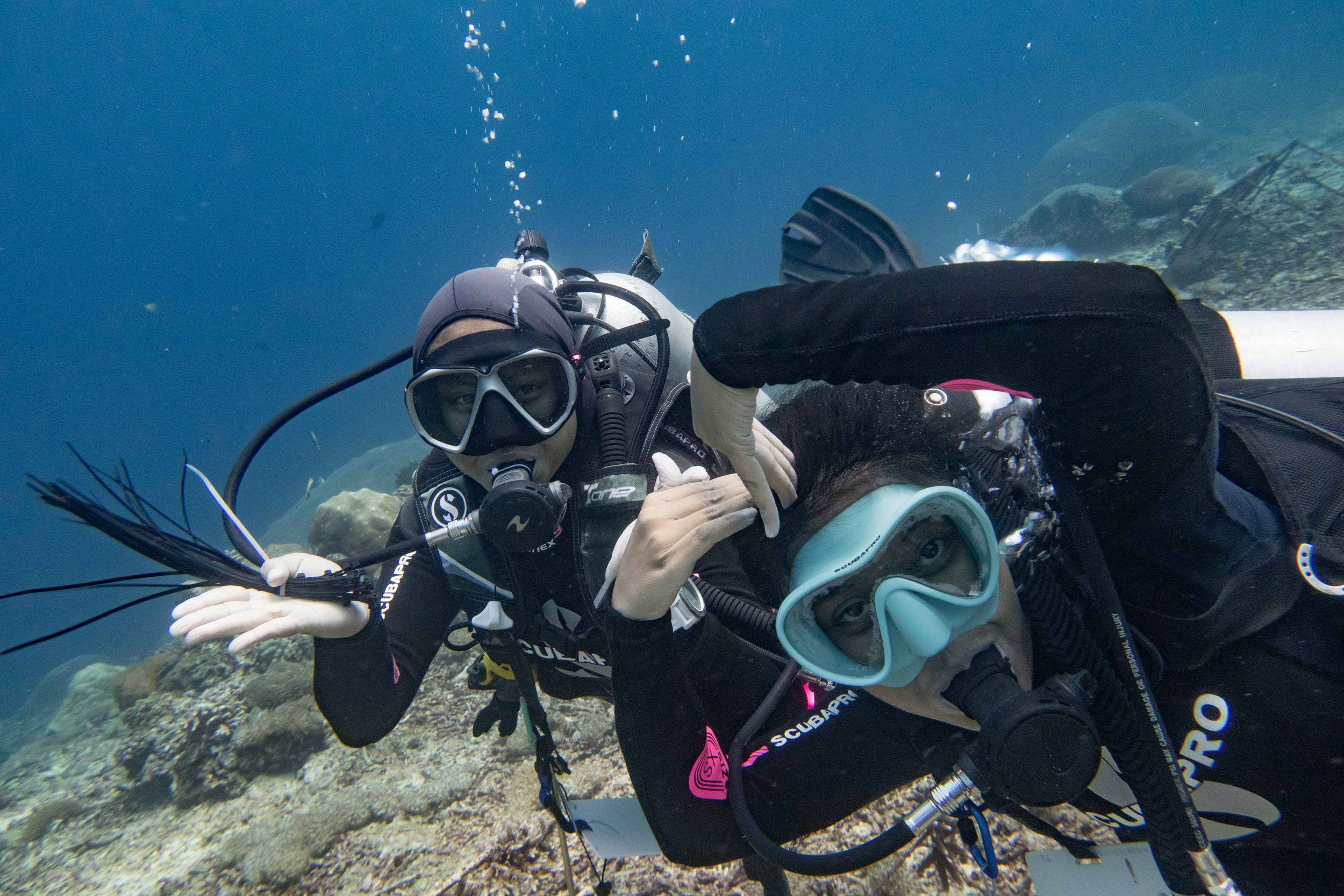
As part of Blue Corner’s research scholarship program for Indonesian university students, each year some early career marine biologists are invited to join us for 2-4 months collecting data for a research project of their choice. Students are based at the Blue Corner Marine Research facilities in Nusa Lembongan island during their internship.
Chusnul is a marine sciences student at Padjadjaran University and worked with Blue Corner marine biologists on a study comparing rates of sponge growth and coral mortality at our coral restoration site in Nusa Penida.

Check out the Abstract from her research paper:
Competition for substrates between sponge species, notably Chalinula nematifera, and coral reefs has emerged as a significant concern in marine ecosystem dynamics.
Substrates play a pivotal role in supporting the growth and survival of diverse marine organisms. This competition extends beyond natural reef ecosystems to include artificial or human-made reef structures, increasingly employed in coral reef restoration efforts worldwide. This research, conducted in the northern part of Nusa Penida, specifically at the Blue Corner coral reef restoration frames, investigates the substrate competition dynamics between Chalinula nematifera and coral reefs in both natural and artificial ecosystems. By analyzing growth rates and mortality of coral, this study aims to comprehensively understand the competitive relationship and its implications for the health and sustainability of coral reef ecosystems. Results indicate Chalinula nematifera's distribution in the restoration area, particularly flourishing in restorations planted between 2020 and 2022. The sponge exhibits invasive behavior, growing excessively on various substrates, including live and dead coral. The correlation between sponge distribution and coral mortality suggests that C. nematifera prefers dead substrates and subsequently spreads to live coral reefs. Temperature plays a crucial role, with rising temperatures leading to coral tissue mortality, coral diseases, and coral bleaching, shifting coral reefs towards dominance by sponges. The study underscores the need for monitoring actions to comprehend the dynamics of growth, recruitment, and distribution in Indonesia's coral reef ecosystem. In conclusion, coral reef restoration faces challenges posed by invasive sponges like Chalinula nematifera, which can thrive on restoration frames. The study emphasizes the importance of long-term monitoring and growth rate studies to assess the potential threat this species poses to marine ecosystems amidst ongoing climate change.

Lydia conducted a research internship with us as part of her MSc from University of Edinburgh in 2019. As one of our earlier research students working on the coral restoration site we were interested in metrics which could be used for monitoring. Together with our Blue Corner Marine Research team she developed a study to measure if corallivorous butterflyfish could be used to indicate whether or not a reef site is successfully restored.
Coral reef ecosystems have been valued as one of the most economically important ecosystems in the world, providing sources of protein, supporting and protecting urban development, and comprising the basis of many cultures and recreational activities. Despite its importance and value, reefs all over the world are being degraded and damaged due to anthropogenic factors. With the aim of protecting the reefs and re-establishing self-sustaining, functional reef systems, many marine protected areas have been established and coral reef restoration projects have been developed, particularly in the Coral Triangle area where biodiversity is the highest.
Check out the research abstract below:
This study aimed to provide an assessment of Blue Corner’s coral restoration project in the Nusa Penida Marine Protected Area in Indonesia by examining the ecological benefits and resilience of the restored structures through comparative analysis of butterflyfish (Chaetodon) and herbivorous surgeonfish (Acanthuridae) and parrot fish (Scaridae) diversity.
Underwater video surveys were collected from three different benthic areas on the North coast of Nusa Penida: 1) restored coral structures, 2) coral rubbles, and 3) natural reefs.

Analysis of video surveys demonstrated that the both diversity of butterflyfish and herbivorous fish were higher on the restored coral structures compared to coral rubbles area. Species composition were also documented and showed a higher species similarity between the restored structures and natural reefs than between coral rubbles and natural reefs.
The results of this study indicate that the ecological functions of the coral restoration structures are being re-established as the relative health of the corals and the resilience of the reef have been improved. The findings in this study provide a basis for future monitoring projects and holds important implications for the management decisions regarding coral restoration projects.
Each semester Blue Corner provides research internships to Indonesian university students to train and study coral reefs with us. During the last program intake we had two Indonesian scholarship students join us here at Blue Corner.
This research project studied the development of fish community structure, by comparing fish on coral restoration structures of different ages.
Read More