
Scientific Pulblications

Early Ecosystem Function Recovery at a Coral Restoration Site
Lorenzo-Garcia, N., Taylor, A.C.F., Pamungkas, E. et al. Early Ecosystem Function Recovery at a Coral Restoration site Revealed Through Process-Based Monitoring Indicators. Thalassas 42, 68 (2026)
Coral reef restoration is increasingly implemented worldwide, yet monitoring commonly focuses on structural endpoints such as survival or coral cover rather than ecological function. This study evaluates early signals of ecosystem function recovery at a coral restoration site established on a degraded rubble reef within the Nusa Penida Marine Protected Area, Indonesia. Monitoring was conducted across 76 artificial reef structures using diver observations and orthogonal photography to quantify benthic composition, structural development, recruitment pathways, trophic interactions, and transplant health. Relationships among monitoring indicators were examined using Spearman correlation analysis to identify linkages between ecosystem characteristics at both the restoration structure and colony levels. Live hard coral and soft coral cover increased significantly with structure age (ρ = 0.60 and 0.50 respectively, p < 0.001), indicating early benthic succession. Coral recruitment showed a strong positive association with coral genus richness (ρ ≈ 0.57), suggesting that more taxonomically diverse restoration structures supported greater establishment of new colonies. Recruitment was dominated by retained fragments (77%) rather than larval settlement (23%), highlighting the importance of fragmentation during early site development. Host-specific analyses further revealed relationships between predator abundance, colony size, and tissue loss within Acropora colonies that were not detectable when all coral genera were analysed together. Mortality estimates derived from colony counts and image-based cover were strongly correlated (ρ = 0.80, p < 0.001), indicating redundancy between these monitoring metrics. These findings demonstrate that analysing relationships among monitoring indicators can reveal early ecosystem development at restoration sites while identifying practical metrics suitable for long-term monitoring programs.
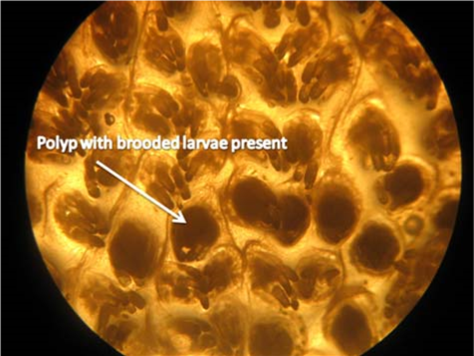
Biological traits of corals under electro-mineral accretion at a coral restoration site in Indonesia
Taylor ACF. 2026. Biological traits of corals under electro-mineral accretion at a coral restoration site in Indonesia. Indo Pac J Ocean Life 10 (1): o100102.
Coral reef restoration efforts risk creating habitats that appear functional yet lack key ecological roles. Electro-Mineral Accretion (EMA)—a method applying low-voltage current to promote calcium carbonate deposition—has been used to enhance coral growth, but its effects on other biological traits remain poorly understood. This study investigated whether corals grown under EMA exhibit trade-offs between growth, reproduction, and skeletal structure compared to natural colonies. At restoration sites in Lombok, Indonesia, colonies of Stylophora pistillata were assessed for fecundity, polyp density, skeletal density, and growth. Growth comparisons of Acropora muricata were also measured between EMA treatments and naturally growing corals. EMA-treated corals showed significantly higher skeletal growth rates but reduced reproductive output, with fecundity 40% lower than natural colonies. Skeleton density was also reduced, suggesting lighter, less robust structures, while differences in polyp density were minor. These patterns indicate that enhanced growth under EMA may occur at the expense of reproduction and structural strength. The findings highlight a key ecological trade-off: faster-growing EMA corals may contribute to short-term reef cover but potentially compromise long-term population viability and resilience. Coral restoration success depends not only on promoting rapid growth but also on preserving reproductive capacity and skeletal integrity. This study underscores the importance of evaluating multiple biological traits when assessing restoration methods and cautions against relying solely on growth enhancement as a measure of ecological success.