
Does it matter how you arrange corals when restoring a reef?
By Andrew CF Taylor | Blue Corner Marine Research | May 2026
When coral restoration teams head underwater to outplant fragments onto an artificial reef structure, dozens of small decisions get made. How many fragments? How far apart? Which species? But one question has received surprisingly little scientific attention: does it matter whether you group fragments of the same species together, or mix different species on the same structure?
New research from our restoration site on the north coast of Nusa Penida, published in the Bulletin of Marine Science, suggests it matters more than you might expect — at least in the critical early months of a coral's life on a restoration structure.
The question
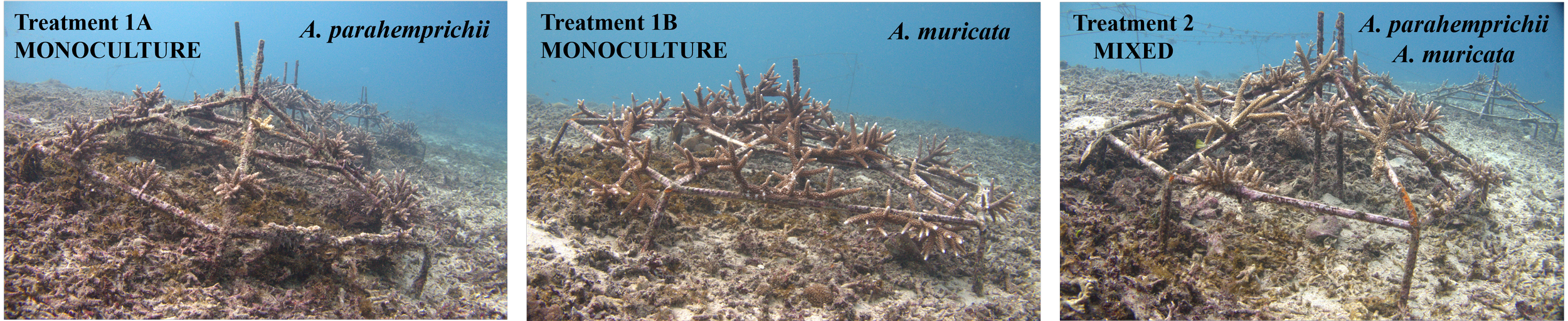
Coral restoration practitioners often face a choice between two broad outplanting strategies. Monoculture outplantings — where all fragments on a given structure belong to the same species — can simplify logistics and reduce competitive interactions between neighbouring colonies. Mixed-species outplantings — where different species share the same structure — are thought to better mimic natural reef assemblages and may support richer ecological function over time.
Both approaches are used widely in the field. But evidence directly comparing their effects on early coral performance has been limited.
What we did
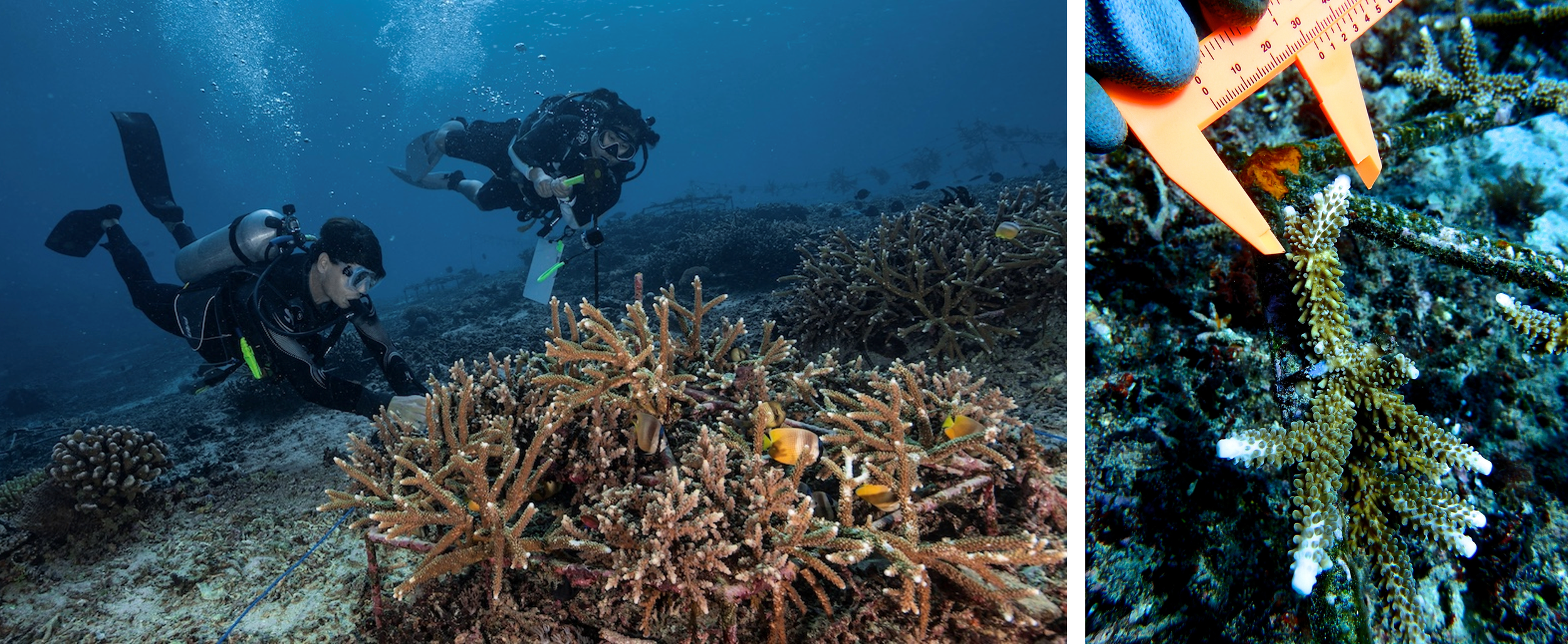
We monitored two Acropora species at our Nusa Penida restoration site over 50 weeks: Acropora parahemprichii and Acropora muricata. Both are branching corals that co-occur naturally in this area and are well-suited to restoration work.
We deployed nine 1 m² artificial reef structures, divided into three treatment groups:
Monoculture structures with only A. parahemprichii
Monoculture structures with only A. muricata
Mixed-species structures with both species interleaved
Each structure received 30 standardised coral fragments, and divers measured colony growth and survival at regular intervals throughout the study period.
What we found
The results were striking — and the pattern was consistent across both species.
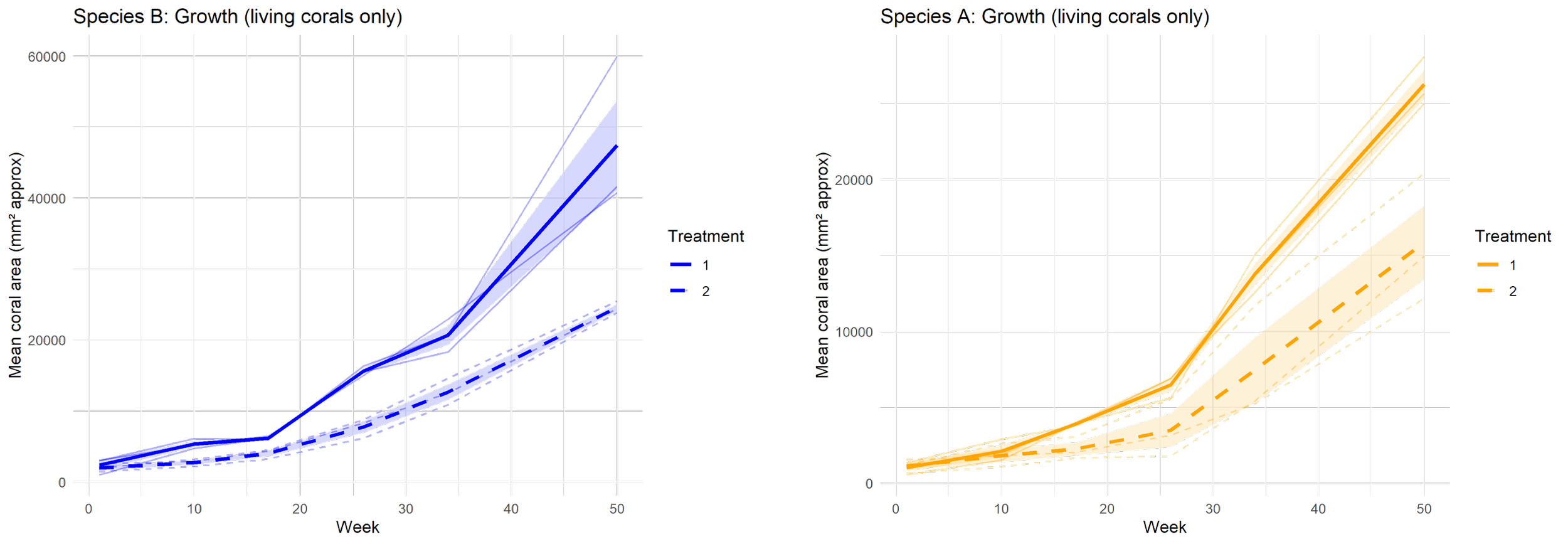
Corals grew significantly faster in monoculture than in mixed-species configurations. The effect was especially pronounced for A. muricata, which grew at nearly double the weekly rate when surrounded by its own kind compared to when it shared a structure with A. parahemprichii.
A. parahemprichii also grew faster in monoculture, with an estimated weekly growth rate of around 483 mm² per week, compared to 290 mm² per week in mixed outplantings — a difference of roughly 40%.
For A. muricata, that gap was even wider: 881 mm² per week in monoculture versus 454 mm² per week in mixed conditions.
Survival, however, told a different story. Outplant configuration had no significant effect on which corals lived or died. Survival rates did differ between species — A. muricata consistently outsurvived A. parahemprichii across both treatment types — but whether corals were planted in monoculture or mixed assemblages made no measurable difference to mortality.
What this means
The fact that growth was suppressed in mixed outplantings — but survival was not — points to what ecologists call a sublethal competitive cost. Corals growing alongside a different species are likely experiencing interspecific competition: sweeper tentacle aggression, altered water flow, shading. These interactions appear to constrain tissue expansion and colony growth without killing the corals outright.
This distinction matters for restoration practitioners. If you were only monitoring survival, you might conclude that mixed and monoculture outplantings perform equally well. But growth is a critical metric too — slower-growing colonies mean slower accumulation of coral cover, which is often the primary goal of early-stage restoration work.
A case for mosaic restoration
This doesn't mean monocultures are simply "better." Reef restoration is more nuanced than that.
Genetic and species diversity are fundamental to long-term reef resilience. Mixed-species assemblages support a wider range of ecological interactions, and diverse genotype mixtures have been shown to reduce disease susceptibility in Acropora. A restoration site that prioritises rapid early growth at the expense of diversity may be poorly equipped to withstand future environmental stressors.
What our findings support instead is a mosaic approach to restoration design: using monoculture patches strategically to accelerate initial coral cover in the early phases, while incorporating genotypically diverse and mixed-species assemblages at broader spatial scales to promote ecological resilience over time.