Coral Planting vs Coral Reef Restoration: What’s the Difference?
Planting coral and restoring a coral reef are often talked about as though they are the same thing… They aren't.
Coral planting can be an important tool used in coral reef restoration. But putting corals onto a degraded reef does not, by itself, mean that the reef has been restored.
The distinction matters because the goal of restoration is not simply to produce more coral. The broader objective is to help a damaged coral reef ecosystem recover.
At Blue Corner Conservation, this distinction shapes how we approach restoration at our long-term project sites in the Nusa Penida Marine Protected Area in Indonesia.
What is coral planting?
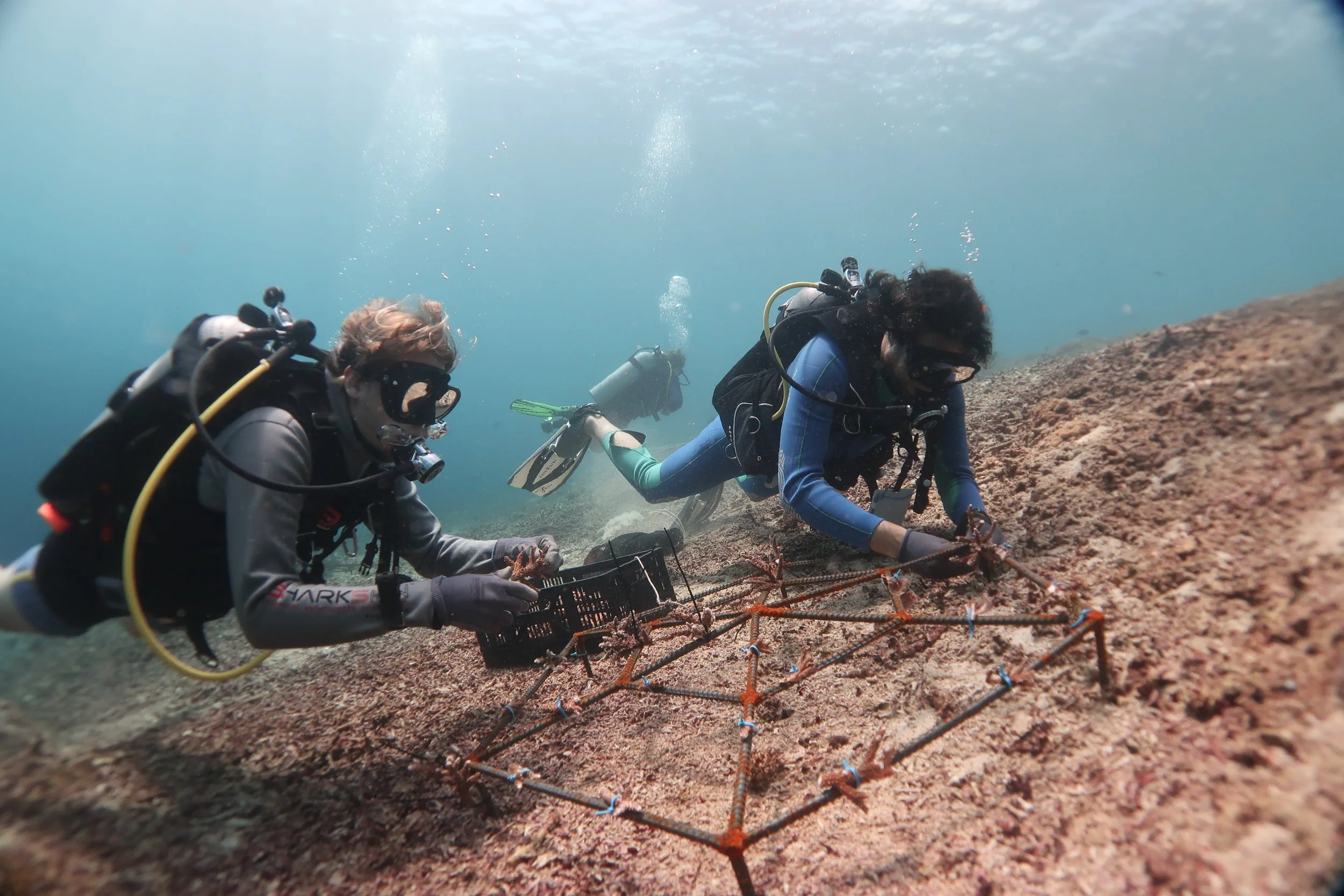
Coral planting generally refers to taking corals that have been propagated, rescued or grown in a nursery and attaching them to a reef.
One common approach is coral gardening. Small coral fragments are collected and grown in underwater or land-based nurseries. Once they have reached an appropriate size, they are transplanted onto degraded reef habitat.
Another approach is direct transplantation, where coral fragments or colonies are moved directly onto the restoration site.
These techniques can rapidly increase the amount of living coral within a degraded area and are widely used in restoration projects around the world.
But there is an important distinction:
Coral transplantation is an intervention. Reef recovery is an outcome.
Installing 1,000 corals tells us how much restoration work was undertaken. It does not tell us whether 1,000 corals survived, whether they grew, whether new corals recruited naturally, whether fish returned, or whether the ecosystem became more resilient.
Understanding reef recovery requires monitoring.
So what is coral reef restoration?
Ecological restoration is fundamentally about assisting the recovery of a degraded ecosystem.
For coral reefs, that means thinking beyond individual coral colonies.
A functioning coral reef contains complex communities of corals, algae, fishes, invertebrates and microorganisms interacting with one another and with their physical environment.
Restoration therefore begins with a different question.
Instead of asking:
“How many corals can we plant?”
we should first ask:
“What is preventing this reef from recovering, and what intervention could help restart that recovery?”
Sometimes coral transplantation may be part of the answer… Sometimes it may not.

Restoration should start with the problem, not the technique
One of the easiest mistakes in coral restoration is deciding on the intervention before properly understanding the cause of degradation.
If poor water quality, destructive fishing, uncontrolled tourism or another ongoing disturbance is preventing reef recovery, planting more corals may achieve very little.
Likewise, some damaged reefs may already be recovering naturally. Active restoration could be unnecessary.
A restoration project should therefore begin by understanding:
What caused the reef to degrade?
Is that disturbance still occurring?
Is the reef recovering naturally?
What is currently preventing recovery?
What ecological condition are we trying to achieve?
What intervention is appropriate for that particular site?
Only then should we decide whether coral transplantation, substrate stabilization, artificial structures, larval enhancement or another restoration technique is appropriate.
A lesson from Nusa Penida
This distinction was important when we began Blue Corner Conservation's restoration work on the north coast of Nusa Penida.
The restoration area consisted largely of unstable coral rubble.
Importantly, we had monitoring information from the area before restoration began. The degraded reef was not simply a recently damaged site that needed time to recover. Areas of unstable rubble had persisted and expanded rather than returning naturally to coral-dominated reef.
This suggested that simply adding coral fragments would not address the underlying problem.
The loose substrate itself was limiting recovery.
Our restoration approach therefore combined physical restoration with biological restoration.
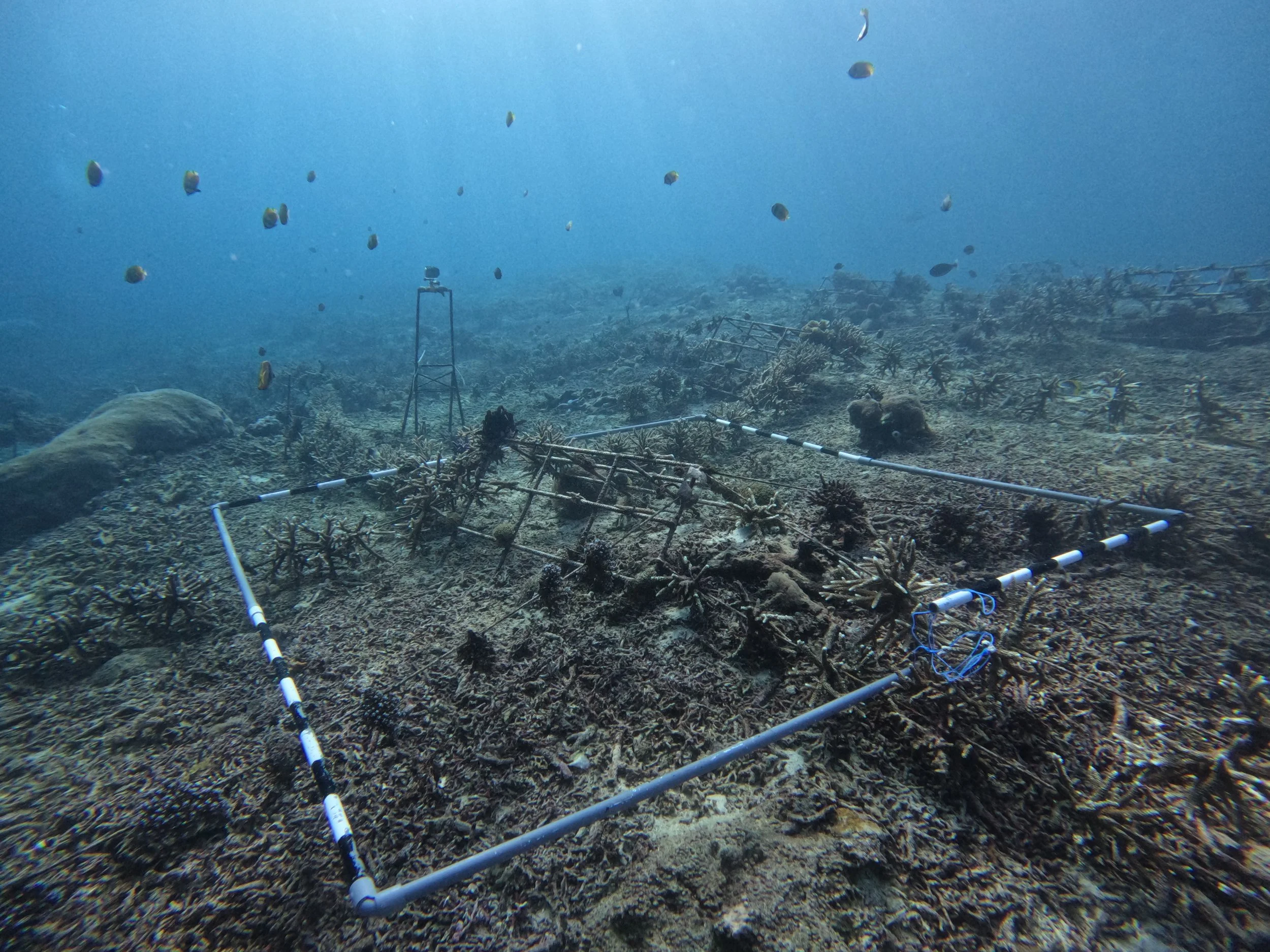
Modular structures were installed to stabilize sections of rubble and create stable habitat. Corals could then be transplanted onto those structures.
The coral planting was therefore one component of a larger restoration strategy.
Planting coral is the beginning, not the endpoint
There is another problem with equating planting with restoration.
A newly transplanted coral is not a restored reef.
Once corals have been transplanted, we need to know what happens next.
Do they survive?
Do they grow?
Do they experience disease or tissue loss?
Do different coral species perform differently?
Do colonies reproduce?
Do naturally recruited corals begin establishing?
Does habitat complexity increase?
Do fishes and reef invertebrates begin using the restored habitat?
Does the developing community begin to resemble the ecological characteristics of healthier reefs?
These questions shift the emphasis from measuring restoration activity to measuring restoration outcomes.
And that distinction is fundamental.
Counting corals planted does not measure restoration success
Numbers such as:
10,000 corals planted
500 restoration structures installed
or
5 hectares under restoration
can be useful measures of project scale.
But they are not, by themselves, measures of ecological success.
Imagine two restoration projects.
Project A plants 20,000 corals but conducts little long-term monitoring.
Project B plants 5,000 corals and follows their survival and growth while also measuring coral cover, natural recruitment, fish communities and changes in the surrounding benthic community.
Which project is more successful?
Without ecological monitoring, we cannot answer that question.
The number of corals planted measures effort.
Restoration success should be measured by ecological response.
What should we measure instead?
There is no single measure that defines a successfully restored coral reef.
The indicators selected should depend on the objectives of the restoration project.
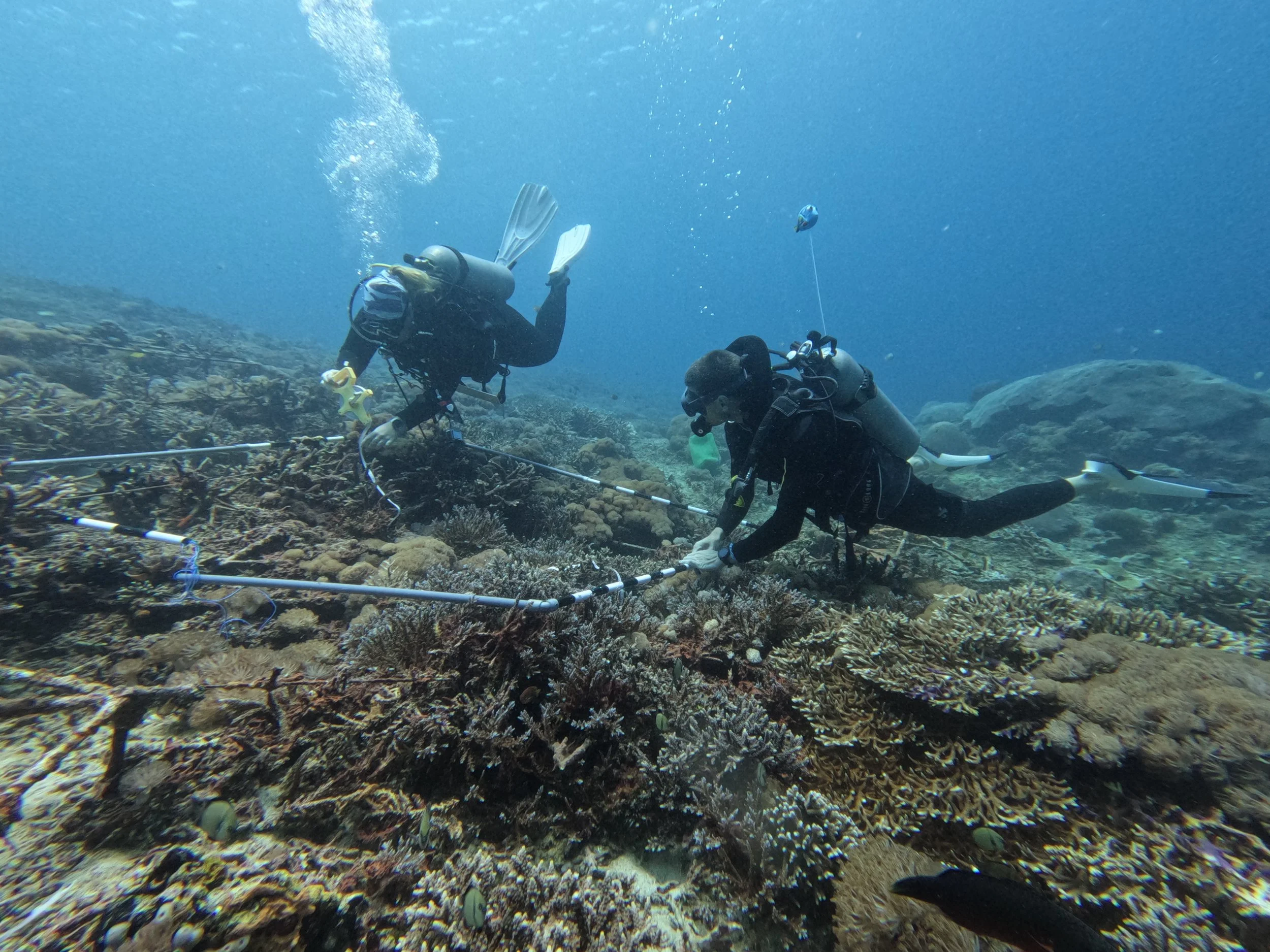
At a minimum, projects using coral transplantation will usually want to understand whether transplanted colonies survive and grow.
But if the stated objective is reef restoration, monitoring should increasingly extend beyond individual transplants.
That could include measures such as:
Coral community recovery
Changes in live coral cover, coral diversity, colony size, recruitment and community composition can tell us whether a developing coral community is becoming established.
Natural recruitment
One particularly important sign of recovery is whether new corals begin establishing without being planted.
Restoration ultimately needs ecological processes to begin doing some of the work.
Fish communities
Corals create habitat. As habitat structure and food resources develop, fish communities may also respond.
Changes in abundance, diversity and ecological functions such as herbivory can therefore provide another perspective on reef recovery.
Reef-associated organisms
Invertebrates, predators, competitors and other reef organisms can provide information about the development of ecological interactions within restored habitat.
Ecological function
Ultimately, a reef is more than its species list.
Processes such as herbivory, predation, recruitment, competition and habitat provision help determine whether a reef ecosystem can persist and continue developing.
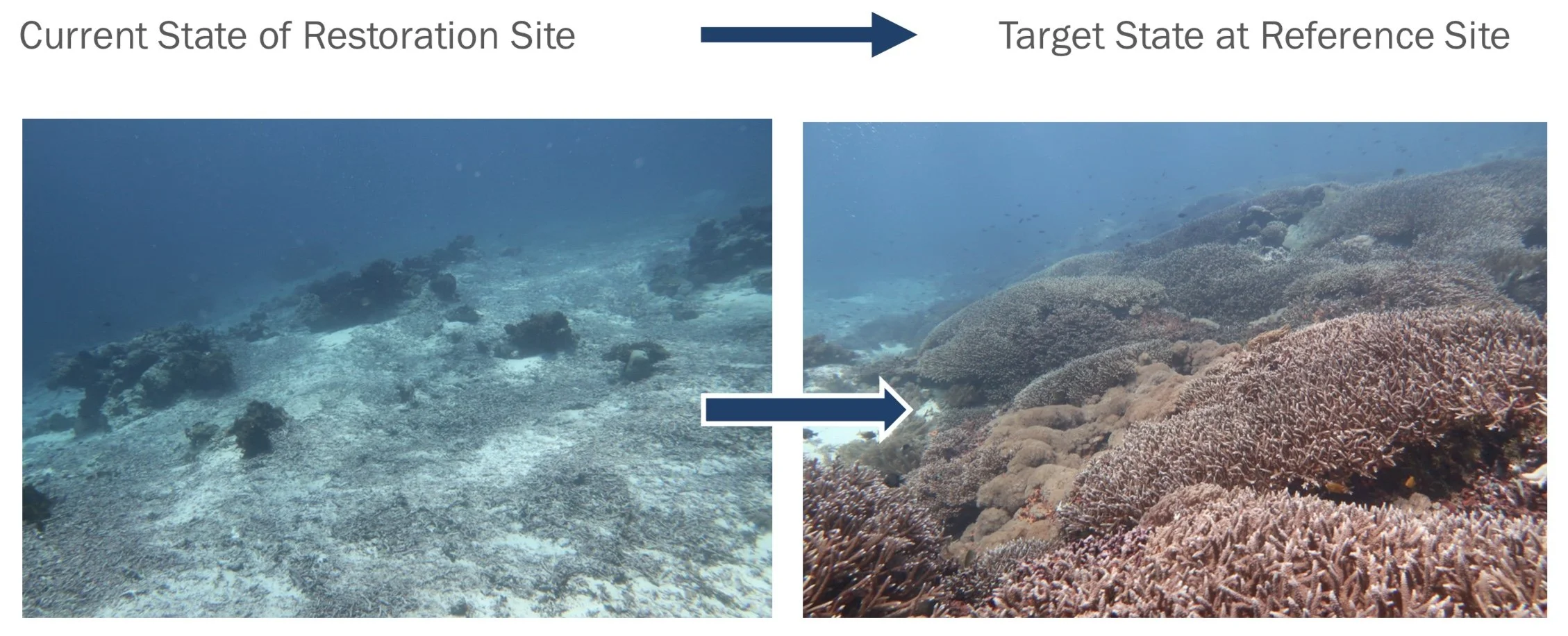
What does a restored reef actually look like?
This question is more difficult than it first appears.
A restored reef does not necessarily need to become an exact replica of what existed decades ago.
Environmental conditions change. Coral communities change. Climate change is altering the conditions under which today's reefs exist.
A more useful approach is often to identify appropriate reference ecosystems or ecological conditions that help us understand the direction in which recovery should proceed.
At Blue Corner, this is why we monitor not only restored areas but also other reef conditions around Nusa Penida.
Healthy reef communities can provide information about characteristics associated with functioning reefs.
Degraded areas can help us understand what happens in the absence of restoration.
The restored site can then be evaluated in that ecological context.
The question becomes:
Is the ecosystem moving away from its degraded state and toward the characteristics of a functioning reef?
That is a much more meaningful measure of restoration than simply counting planted corals.
Coral restoration cannot solve climate change
There is also a larger limitation that needs to be acknowledged.
Coral restoration is not a substitute for addressing climate change or other causes of reef degradation.
No amount of coral planting can compensate globally for continued ocean warming.
Likewise, restoration makes little sense if local pressures responsible for degradation remain unmanaged.
Restoration should therefore be viewed as one tool within a much broader approach to coral reef conservation.
Marine protected areas, fisheries management, water-quality improvement, climate mitigation and reducing local disturbances remain essential.
Restoration can help damaged reefs recover, but it cannot remove the need to address why reefs are declining in the first place.
From coral gardener to restoration practitioner
This distinction also changes how we think about coral restoration training.
Learning how to fragment, propagate and transplant coral is useful.
But those skills alone do not make someone a restoration practitioner.
A restoration practitioner should also understand reef ecology, project planning, site selection, causes of degradation, restoration objectives, monitoring design and how to evaluate ecological outcomes.
This is why Blue Corner's training programs combine three areas:
Coral Reef Ecology → Reef Monitoring → Coral Restoration
Students first develop an understanding of the ecosystem.
They then learn how to measure reef condition.
Only then do we introduce restoration interventions.
The objective is not simply to teach someone how to plant a coral.
It is to teach them how to think about restoring a reef.
Lessons from more than seven years of restoration in Nusa Penida
Blue Corner's Nusa Penida restoration program has been operating since 2018 under the direction of marine biologist, restoration practitioner and PhD researcher Andrew Taylor.
Taylor is a Certified Ecological Restoration Practitioner and has worked in coral reef restoration for more than two decades, from his academic research through to directing long-term restoration projects in Indonesia and globally. His work now focuses particularly on how restoration success should be measured and how monitoring can determine whether restored reefs are actually recovering as ecosystems.
That perspective has increasingly shaped the way we think about restoration at Blue Corner.
Installing restoration structures and transplanting coral can create rapid and highly visible changes.
But the interesting part happens afterwards.
Over years, transplanted colonies grow and interact. Habitat structure develops. Fish occupy the structures. New corals recruit. Predators and competitors appear. Some colonies survive while others die.
The site begins behaving less like a collection of planted corals and increasingly like an ecosystem.
Understanding that process is now one of the major focuses of our research.
So, what is the difference between coral planting and coral reef restoration?
The simplest way to think about it is this:
Coral planting is something we do.
Coral reef restoration is what we are trying to achieve.
Planting can be an extremely useful restoration technique. But successful restoration requires us to think beyond the number of corals attached to the reef.
We need to understand why the ecosystem was degraded.
We need to select interventions that address barriers to recovery.
We need to monitor what happens afterwards.
And ultimately, we need to determine whether the ecosystem itself is beginning to recover.
That distinction might seem semantic.
In practice, it changes how restoration projects are designed, implemented and evaluated.
And it changes the definition of success from:
“How many corals did we plant?”
to the much more important question:
“Is the reef recovering?”
Learn Coral Reef Restoration in Indonesia
Blue Corner Conservation runs coral restoration training and scientific internships through our long-term restoration and monitoring programs in Bali, Indonesia.
Participants learn coral reef ecology, scientific reef-monitoring techniques and practical coral restoration while working alongside our team on active restoration and research projects.
Explore our Coral Restoration Training and Marine Conservation Internship programs to learn how restoration works beyond simply planting coral.